

How Much Money Did It Cost To Repair Hurricane Katrina
| | Parts of this commodity (those related to article) need to be updated. (March 2022) |

The reconstruction of New Orleans refers to the rebuilding process endured past the city of New Orleans afterwards Hurricane Katrina destroyed much of the city on Baronial 29, 2005. The storm acquired levees to fail, releasing tens of billions of gallons of water. The levee failure contributed to all-encompassing flooding in the New Orleans area and surrounding parishes. About 80% of all structures in Orleans Parish sustained water damage. Over 204,000 homes were damaged or destroyed, and more than 800,000 citizens displaced—the greatest displacement in the United states of america since the Grit Bowl of the 1930s.[1] Current of air impairment was less severe than predicted. The damage that took place that needed to be repaired cost about $125 billion.
Reconstruction was hindered by bureaucratic problems and funding problems with the U.Due south. Army Corps of Engineers and the Federal Emergency Management Bureau (FEMA). Relief agencies provided supplemental relief. By mid-June 2006, the urban center was again hosting conventions and promoting tourism.

After the flooding: Building displays lines from diverse levels of long standing floodwaters and has been deemed "unhabitable".
Reconstruction [edit]
Residents were authorized to render to examine homes afterwards the storm on Monday, September v, 2005. In downtown New Orleans, several places were indeed producing power. Due to contaminated water and uninhabitable conditions, the Mayor ordered that all citizens be evacuated by September 6.
Levee and pump repairs [edit]
The Corps of Engineers repaired the 55 levee breaches including the Industrial Canal, 17th Street Canal, and London Avenue Culvert since shortly later on the storm, and continues to work on mitigating the risk posed past flooding.[ citation needed ]
Utilities [edit]
Testing found the flood waters were non unusual. The Louisiana Department of Environmental Quality and the U.Southward. Environmental Protection Bureau (EPA) in March 2006 alleged all parts of New Orleans safe; no soil was contaminated and the air quality was pure.
H2o and sewage services were gradually restored. The first section of the city to have a "eddy water" order lifted was in the high ground of the old crescent along the River from the French Quarter to sometime Carrollton on October half-dozen, 2005. The final section of the city to have such an order lifted (a section of the Lower 9th Ward) was on October 9, 2006.[ commendation needed ]
Federal funding argue [edit]
Some people, including Speaker of the House Dennis Hastert, questioned whether federal funds should pay to rebuild New Orleans. Others consider New Orleans's unique cultural heritage and history to exist every bit important to the United States as, for example, Venice is to Italian republic; they maintain that to not rebuild and reoccupy the city would be an immeasurable loss in that regard. The Times-Trivial ran a forepart-page editorial arguing for national aid.[ commendation needed ] It has been argued that since the US Army Corps of Engineers has had oversight over the levee system since the Cracking Mississippi Alluvion of 1927 and most of the destruction in the city occurred due to the levee failure, the federal authorities should exist responsible for rebuilding. Senator Mary Landrieu said that Louisiana's offshore petroleum leases generate billions of dollars in revenues for the federal government's full general fund, more than would be needed to restore wetlands and upgrade levee/flood control for South Louisiana to withstand category 5 storms. She argued that the federal government should either earmark some of that income for such projects or allow Louisiana to keep a pregnant portion of that acquirement then the state could take care of its needs itself. If New Orleans is not rebuilt, it volition sink. They demand to rebuild New Orleans.
Rebuilding, social justice, and community life [edit]
Frederic Schwartz, the architect selected by the citizens of New Orleans and the New Orleans City Planning Commission to replan one-tertiary of the city for 40% of its population[2] explained how the opportunity for rebuilding the city could be a risk to strengthen social justice and community life:
The planning of cities in the confront of disaster (natural and political) must reach across the rough-and-tumble of short-term recovery. Disaster offers a unique opportunity to rethink the planning and politics of our metro-regional areas – it is a chance to redefine our cities and to reassert values of environmental care and social justice, of community edifice and specially of helping the poor with programs for quality, affordable, and sustainable housing.[three]
Equally atomic number 82 planners for Commune 4, the commune that includes the "largest concentration of public housing in the city" (Iberville, St. Bernard, Lafitte, and B. Due west. Cooper), Schwartz challenged his team to make "every endeavor to involve the residents and the community in the planning effort," while ensuring that the design of the new housing "could maintain the wait and feel of surrounding neighborhoods with a mix of both modernistic interpretation of celebrated typologies and new urbanist models."[3]
Relief agencies [edit]

Lining up at a Ruddy Cross food & supply center in a formerly flooded Uptown neighborhood, mid-Oct 2005
Relief agencies helped many returnees. The American Red Cantankerous made a belated just nonetheless significant entry into the city in mid-September; and by the kickoff of October had a number of relief centers gear up around the city. These provided hot meals, packaged nutrient, bottled water and other supplies like diapers, mops, and dust masks. The Conservancy Ground forces also had many stations giving food. Temporary free clinics provided some medical intendance. Towards the end of 2005, the relief centers were wound down, starting with those in performance parts of the city. Red Cross meals connected at a much smaller scale into 2006 from trucks traveling around the worst-hitting and poorest neighborhoods.
The Southern Baptist Convention sent feeding units to New Orleans and the Mississippi Gulf Coast the day after Katrina struck New Orleans. Since this time, the Southern Baptist Convention through its N American Mission Board established an ongoing project called Performance Noah Rebuild, (non to be confused with the Operation Noah sponsored by the Urban center of New Orleans) which has hosted thousands of volunteers and teams from all over the Usa. The volunteer teams helped in the reconstruction efforts in New Orleans and the surrounding parishes. Starting time Baptist Church of New Orleans worked manus-in-hand with Habitat for Humanity with the Baptist Crossroads Project, in an effort to rebuild homes in the Upper Ninth Ward.
Food Not Bombs was agile in providing food early on after the disaster. A customs kitchen was ready upwardly commencement in Washington Square in Faubourg Marigny; after a few months it was moved to a park past Bayou St. John before being airtight down. A number of church groups and smaller charities gear up upwardly assist for a time.
Common Ground Collective had ii relief centers in the 9th Ward of New Orleans, providing food, clothing, and a tool library. The larger center was in the Upper 9th Ward, with a smaller one in the worst hit part of the Lower 9th Ward. They also helped gutting houses.
The Church building of Jesus Christ of Latter-day Saints began bringing in load after load of food and h2o for local members and residents to several areas of the urban center. Thousands of church members came in on rotating weekends to help clean upward debris, gut houses and cut up fallen trees all over the city. In add-on to the home repairs, the church building full-time counselors were available to provide mental wellness assistance; and church employment centers—offices that help with finding jobs—opened their doors to everyone, regardless of religion.
Habitat for Humanity has been active in building homes at an accelerated pace since the storm. Initially, the organization had volunteers gutting homes; but since returned to its primary mission of fighting poverty housing. Catholic Charities too was very active with volunteers repairing damaged houses and churches throughout the expanse. Camp Hope in Violet, LA housed volunteers in the Hurricane Katrina recovery try of St. Bernard Parish since June one, 2006.

Build Now is a non-profit system that played an active office in bringing New Orleans families dorsum home. The non-profit, a licensed and insured residential contractor, constructed site-congenital, elevated houses on hurricane-damaged lots. The homes reflect the style and quality of traditional New Orleans[ citation needed ] architecture. Build Now brought more than than a dozen New Orleans families back domicile, including structure effectually the Lakeview, Gentilly and the Upper and Lower Ninth Ward areas. The organisation moved New Orleans families back abode since beginning operations in 2008.
The Jazz Foundation of America is a not-profit organization that helped New Orleans musicians directly past paying the first month's hire for new homes, getting nearly $250,000 worth of donated instruments to musicians, giving pro bono counseling, advocacy, legal counseling, and creating a long term employment plan that put displaced musicians back to work performing costless concerts in schools and nursing homes, in eight states. In 2005 The foundation held an auction to benefit musicians afflicted by Hurricane Katrina[4] Thanks to the generosity of the foundation'due south chairwoman, Ms. Agnes Varis,[5] they were able to create employment programs which accept made information technology possible to keep the artists and their music alive in New Orleans.[half-dozen]
Repopulation and restoring homes [edit]

The corner of Wilton Drive and Warrington Bulldoze, November 2005
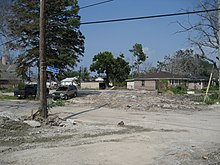
The same corner, September 2006

The aforementioned corner, March 2007
Repopulating the city has been steady but gradual, with neither the rapid render of most evacuees hoped for by some optimists nor the long term "ghost town" desertion of the metropolis feared by some pessimists. In early on 2006, the RAND Corporation estimated that, even in 2008, the city'south population would only be piffling more than than half what information technology was before the storm hit; however by July 2007 the city's population was estimated at about two-thirds (or close to 300,000 residents) of that earlier the disaster.[vii]
Even in 2009, many homes and homeowners were however devastated. Some organizations, like the statewide Louisiana Disaster Relief Foundation or the neighborhood-based United Saints Recovery Projection, are nevertheless working to provide support to homeowners in rebuilding their homes.
The areas with little or no flooding were the outset to be officially reopened, have utilities restored, and a sizable portion of residents and businesses return.
Flooded-out areas presented more problems. The city had no comprehensive plan for what to exercise nigh flooded areas. Thousands of holding owners have been gutting and repairing their holding, some in the lowest lying areas of town. Contractors and workers from out-of-state and other countries came in bully numbers doing sabotage and reconstruction piece of work, some filling hotels and rental property, others living in trailers and tent cities prepare in city parks and parking lots. Sportscaster Mike Tirico incorrectly generalized on Mon Night Football in September 2006, some areas, like the Lower Ninth Ward and Gentilly, still looked as desperately damaged as the mean solar day the storm passed through. However, in each of those neighborhoods thousands of truckloads of debris were removed, hundreds of unsalvageable houses demolished, and work on gutting and repairs has been constant since the city has reopened.
Hundreds, if not thousands, of New Orleanians lived in the largely intact upper stories of their homes while the flood damaged downstairs got repaired, often being stripped to the wall studs in the process.
The U.Southward. Army Corps of Engineers set up the "Blueish Roof Program" of putting blue tarps over damaged roofs. The tarps kept out rain until more permanent roof repairs could be fabricated. Thousands of blue tarps were seen throughout the city; however, a number of official restrictions meant some residents were unable to benefit from this recovery program. Likewise, a number of subcontractors paid by the Corps only did "easy" low-pitch one-story roofs, choosing not to return to exercise more difficult roofs.[ commendation needed ] Some New Orleanians lived for months in homes with sizable holes in their roofs. Amongst the pop handouts at Red Cross relief stations were 5-gallon buckets, many put to employ as pelting catchers. Six months afterward the storm, many of the hastily placed blueish roof tarps were in tatters, leaving those homes vulnerable once more. Many people did not succeed in getting permanent roof repairs from such reasons as long waiting lists for reliable contractors and waits for insurance payment.[ citation needed ]

Trailer exterior formerly flooded house in Broadmoor has complaint about no electricity painted on side; April iii, 2006
Seven months after the storm, two-thirds of the requested FEMA trailers (designed for short term emergency housing immediately afterwards a disaster) had been delivered. Many of these trailers, however, could not exist occupied or, if occupied, were not properly functional. Delays of weeks or months in hooking upwardly electricity and water to trailers were mutual, and mechanical and bureaucratic problems prevented utilise of the trailers.[ commendation needed ]
In June 2006, the State of Louisiana finally awarded a contract to DRC, Inc. of Mobile, Alabama to remove thousands of abandoned cars strewn throughout New Orleans after Hurricane Katrina.
Differing circumstances [edit]
Reconstruction has been easiest and quickest in the areas least damaged by the storm, by and large corresponding to the parts of the city developed earlier about 1900. These areas were built on naturally higher basis along the River front (such equally Old Carrollton, Uptown, the Old Warehouse District, the French Quarter, Old Marigny, and Bywater), along with areas along natural ridges (such as Esplanade Ridge, Bayou St. John, Gentilly Ridge). Nearly of these older areas had no flooding at all or escaped serious flooding because of the raised design of older architecture which prevented floodwaters from entering homes. Another loftier area, much of which escaped serious flooding, was the ready of Lake Shore developments between Lake Pontchartrain and Robert East. Lee Boulevard, congenital at a higher level than nearby land from mid-20th century dredging.
Due to the direction of the storm and the movement of storm surge, the West Bank section of the city, Algiers was spared flooding and became the first part of the city itself to officially reopen to residents.
In neighboring Jefferson Parish, the West Bank communities were similarly spared all but some wind harm (with a few spots of small pelting-generated flooding). On the Due east Depository financial institution, while parts of Metairie and other Jefferson communities experienced some flooding, due to lack of levee breaches this was much less severe than across the Parish line in Orleans (or the destruction of the 1947 Fort Lauderdale Hurricane which flooded almost of Jefferson's East Bank).
Reconstruction of each section of the area has been addressed in the Regular army Corps LACPR Final Technical Report which identifies areas to not exist rebuilt and areas buildings need to be elevated.[viii] The Technical Report includes locations of possible new levees; suggested existing levee modifications; "Inundation Zones"; "Water depths less than fourteen feet, Heighten-In-Identify of Structures"; "Water depths greater than 14 anxiety, Buyout of Structures"; "Velocity Zones"; and "Buyout of Structures" areas for five different scenarios. The Corps of Engineers will submit the report to Congress for consideration, planning, and response in mid-2009.
A larger percentage of white residents returned to their homes than did blackness residents. This was attributed to an unwillingness of planners to rebuild depression-income housing.[9] In September 2005, the Washington Mail service noted former ten-term Republican Congressman Richard H. Baker from Baton Rouge reportedly told lobbyists, "We finally cleaned up public housing in New Orleans. We couldn't practise information technology, but God did", and criticized his lack of concern for the lower income residents.[10]
FEMA caseworkers were charged with the responsibleness of helping evacuees find housing and employment. Caseworkers had to assistance some one-time residents realize that moving dorsum was unrealistic because some of the city was not being rebuilt. This created a diaspora every bit many evacuees wished to return to New Orleans but were not able to.[11]
Large areas of the city's public housing were targeted for sabotage, inciting song protests from some, including architecture critic Nicolai Ouroussoff.
Homeless residents [edit]
A challenge facing New Orleans was the exceptionally large homeless population created past Katrina. The number of homeless people living in New Orleans doubled to 12,000 people betwixt the hurricane and mid-2007.[12] With a post-Katrina population of 300,000 people, this meant that ane in 25 people were homeless, an extremely high number and about three times that of any other US city.[xiii] Most of the homeless were Katrina evacuees who returned to higher rents or who barbarous through the cracks of the federal system that was to provide temporary housing after the disaster. There were also some workers who came from out of country for the post-Katrina rebuilding boom but who after lost their jobs. [xiv] Compounding this problem, the number of beds for the homeless in the city decreased from a count of two,800 before the storm to two,000 every bit of May 2008.[15]
The New Orleans Legal Assist Corporation's Homeless Department worked overtime in January 2009 and reevaluated the homelessness rate. They found that the post-Katrina homeless population decreased by 64% since the last survey two years prior.[16]
UNITY of Greater New Orleans reported one,188 homeless people later their 2022 Betoken-in-Time count performed in January.[17] As of 2022, New Orleans has maintained a "functional zero" in veteran homelessness for three years. Going forrad, UNITY'south efforts are focused on support for chronically homeless people with concrete and/or mental disabilities.
Neighborhood and community-based organizations [edit]
Neighborhood and community-based organizations played a pregnant role in the reconstruction endeavour after Katrina. Neighborhood associations and resident-leaders from communities across the metropolis established an data-sharing network called the Neighborhoods Partnership Network (NPN)[18] where they shared lessons learned through the rebuilding process with each other as well equally information about important upcoming citywide or neighborhood planning meetings, resources (on volunteers, tools, programs and application processes, etc.), and calls and offers for help and collaboration. Network members shared information and resources identified through the network with their own communities and neighbors.[19] Early on, members too used NPN as a way to identify and collectively point out issues and collective priorities to local government officials and agencies and propose possible solutions. The network somewhen established a paper, The Trumpet, that was circulated locally to disseminate information, highlight and celebrate progress, and to facilitate connections for collaboration.[xx]
Businesses [edit]
Confined were the first businesses to reopen in many areas; two remained open in the French Quarter fifty-fifty during the worst of the storm and the official mandatory evacuation. Almost other businesses, such as gas stations, appliance stores, and supermarkets, followed somewhat subsequently as they required more than work earlier they could reopen. Iii months after the tempest, most open restaurants were serving food and drink in disposable plates and cups because of the shortage of dishwashers. Despite many restaurants offer wages double pre-Katrina levels for dishwashers, at that place were few takers equally untrained laborers were able to make more money in demolition- and reconstruction-related industries. Ten months later, things had improved, though at that place were nonetheless labor shortages in many service industries.
Some of the few businesses to practise significantly meliorate business later on Katrina than earlier were new car dealers. Flooding totaled an estimated 200,000 vehicles in Metro New Orleans, and dealers able to get in shipments of new cars quickly plant customers. Later on local reporters found a used car dealer selling partially cleaned up flooded cars with restored engines but nonetheless soggy trunks, the country legislature quickly passed legislation mandating that cars declared totaled must be dismantled, crushed, or otherwise disposed of and could not be resold.
Lieutenant Governor Mitch Landrieu (who after became Mayor of New Orleans) alleged that Louisiana housed America'south soul, and its revival was of paramount importance.[21] Equally New Orleans began reviving its local businesses, the reestablishment of the city's restaurants, peculiarly mom and pop eateries, received fervent local and national support. New Orleans'south cuisine has largely maintained its cultural distinctiveness, linking its citizens with the city's creole roots. Long earlier Hurricane Katrina, 'local' food in New Orleans represented a framework for discussing America's racial binary—a paradigm in which the urban center has more often than not attempted to resist. Thus, even if race prevented a portion of New Orleanians from "[acknowledging] that they do, indeed, share one civilisation", civilisation became recognized as "something shared around which the city'south residents could rally" during an arduous rebuild.[22] By emphasizing the restoration of non only New Orleans'due south economical but likewise its cultural capital, the urban center yielded the additional benefit of a reinvigorated social upper-case letter.
Tourism and events [edit]
The American Library Association held its annual convention in New Orleans in June 2006; the estimated 18,000 attendees represented the first citywide convention in New Orleans since Hurricane Katrina. The National Association of Realtors likewise held their annual convention in New Orleans bringing 30,000 attendees to the city in November 2006.[23] The HIMSS healthcare information technology convention and the American College of Cardiology convention, both held in the spring of 2007, each had more than 24,000 attendees.[24] The Essence Music Festival returned to the Crescent City in July 2007 after beingness displaced to Houston in 2006. Several national travel guides have once once again listed New Orleans as one of the superlative 5 places to visit in the country.
The Bayou Archetype, the traditional football game between Southern University and Grambling State University, returned in Nov 2006 after existence displaced to Houston for its 2005 game. The National Football League fabricated a commitment to the city with the return of the New Orleans Saints, following speculation nearly a move to San Antonio or Los Angeles. The National Basketball game Association has made a commitment with the return of the New Orleans Hornets (now the Pelicans), which played in both New Orleans and Oklahoma City, in the 2005–2006 and 2006–2007 seasons, returning fully for the 2007–2008 season. (Oklahoma City became a permanent member of the NBA in the 2007–2008 flavour.) New Orleans was granted the 2008 NBA All Star Game, which commonly generates millions of dollars in revenue for the host city. Tulane Academy hosted the first and 2nd rounds of the 2007 NCAA Men's Sectionalization I Basketball Championship. The Hornets were renamed to the Pelicans before the 2022–2014 season, and the former name was reclaimed by the and so–Charlotte Bobcats the next season.
The Superdome has since hosted several college football basin games, and a Super Bowl. The New Orleans Bowl resumed in Dec 2006, and the Sugar Bowl and 2008 BCS National Championship Game took in January 2008. New Orleans hosted the Super Bowl in 2022 for the offset fourth dimension since Hurricane Katrina. In Feb 2022, the New Orleans Saints won Super Bowl XLIV.
In mid-March 2007, a local grouping of investors began conducting a written report to see if the city could support a Major League Soccer team.[25]
Major seasonal events, such as New Orleans Mardi Gras and the Jazz and Heritage Festival, were never displaced, occurring at other times of year.
Long-term redevelopment [edit]
The Greater New Orleans Urban Water Plan [edit]
The Greater New Orleans Urban H2o Plan (UWP) is a collaborative, multibillion dollar post-Katrina redevelopment program for the New Orleans metropolitan area. Originally released in 2022, the UWP is the result of collaborative efforts among Greater New Orleans, Inc., local civic leaders, and stormwater management experts.[26] Waggonner & Ball Architects, a individual firm based in New Orleans, coordinated the projection with the back up of Greater New Orleans, Inc. The project sought to rethink New Orleans'south stormwater management and drainage infrastructure to ensure the city'southward longevity amidst subsidence and climatic change concerns. Additionally, a major component of the project was the revitalization and economic evolution of areas inside the metropolis that had been severely impacted past the hurricane. In November 2022, Waggonner & Ball produced the UWP in 3 parts: Vision, Urban Design, and Implementation.
Waggonner & Ball coined the term "living with water"[27] to depict the UWP's emphasis on storing and property h2o within the urban center limits rather than pumping water out into major waterways, such as the Mississippi River and Lake Pontchartrain. The project views water as an asset and draws upon the Dutch model for flood control in holland. The program relies on greenish infrastructure practices, such as bioswales, greenways, blueways, rain gardens, and permeable pavement, to capture and shop backlog stormwater.[28] The project is divided among the Jefferson–Orleans basin, the Orleans E Bowl, and the St. Bernard Basin, and is a coordinated effort among Jefferson, Orleans, and St. Bernard Parishes. Waggonner & Ball estimates that fully implementing the UWP would cost $6.ii billion with long-term projected benefits of $22 billion,[29] whereas maintaining the pre-Katrina infrastructure model would cost New Orleans more than $10 billion over the next few decades.[28]
The project has served as a primary guide for the New Orleans City Council's Capital Improvement Plan since the adoption of the 2022–2024 Capital Improvement Plan in September 2022 under Mayor LaToya Cantrell.[30]
See as well [edit]
- Bring New Orleans Back Committee
- Civil engineering science and infrastructure repair in New Orleans subsequently Hurricane Katrina
- Musicians' Village
- Lake Borgne Surge Barrier
- Seabrook Floodgate
References [edit]
- ^ "Fast Facts nigh the Aftermath". Archived from the original on 2008-01-02. Retrieved 2007-09-18 .
- ^ SchwartzArch website, retrieved February 26, 2022.
- ^ a b Schwartz, Frederic, "New Orleans Now: Design and Planning After the Storm," in "Natural Metaphor: An Anthology of Essays on Architecture and Nature", retrieved Feb 21, 2022.
- ^ globalrhythm.net. 2009-thirteen-ten. URL: http://www.globalrhythm.net/WorldNews/JazzFoundationAuctionWillBenefitMusiciansHurtbyKatrina.cfm Archived 2022-03-15 at the Wayback Machine. (Archived by globalrhythm.net at http://www.globalrhythm.net/WorldNews/JazzFoundationAuctionWillBenefitMusiciansHurtbyKatrina.cfm Archived 2022-03-xv at the Wayback Machine)
- ^ "The Jazz Foundation" (PDF). Archived from the original (PDF) on 2022-05-xxx. Retrieved 2014-12-22 .
- ^ jazzfoundation.org. 2009-13-10. URL: http://world wide web.jazzfoundation.org/programs.swf [ permanent dead link ] . (Archived past jazzfoundation.org at http://www.jazzfoundation.org/programs.swf [ permanent dead link ] )
- ^ for the role of civil social club in the procedure of rebuilding New Orleans, see: Michael Southward. Falser: Der Wiederaufbau von New Orleans nach Hurricane Katrina – Gedanken zum Condition der Zivilgesellschaft im Kontext von Natur- und Kulturkatastrophen. (also in english: Rebuilding New Orleans later on Hurricane Katrina—Thoughts on the Role of Civil Society in the Context of Natural and Cultural Disasters) In: Meier, H.-R., Petzet, Chiliad., Will, T. (Hrsg.) Cultural Heritage and Natural Disasters. Risk Preparedness and the Limits of Prevention. ICOMOS-Reihe: Heritage at Risk, Special 2007. München, Dresden, 2008, S. 109–122.
- ^ "Archived re-create". Archived from the original on 2009-06-26. Retrieved 2009-06-thirty .
{{cite web}}: CS1 maint: archived copy as title (link) - ^ "The Disneyfication of New Orleans" "The Guardian UK" Baronial 28, 2008. Retrieved August 28, 2008
- ^ "Some GOP Legislators Hit Jarring Notes in Addressing Katrina" "The Washington Post" September ten, 2005. Retrieved August 28, 2008.
- ^ Sterett, Susan. 2022. ["Disaster, Displacement, and Casework: Incertitude and Aid afterwards Hurricane Katrina]" Police force & Policy.
- ^ "Homeless camp appears near City Hall", "WWLTV New Orleans" July 25, 2007. Retrieved August 28, 2008. Archived October 13, 2008, at the Wayback Machine
- ^ For comparison, Atlanta, which comes 2d nationally among major cities in its homelessness rate to mail service-Katrina New Orleans, has a homelessness charge per unit of 1.4%.
- ^ "New Orleans' homeless rate swells to 1 in 25" "Usa Today" March 17, 2008. Retrieved Baronial 28, 2008.
- ^ "Resources Scarce, Homelessness Persists in New Orleans", "The New York Times" May 28, 2008. Retrieved August 28, 2008.
- ^ "Homeless Problems" Archived 2007-12-24 at the Wayback Automobile "New Orleans Legal Aid" Retrieved Jan 13, 2009.
- ^ "Trends in Homelessness in New Orleans and Jefferson Parish". UNITY of Greater New Orleans.
- ^ "Neighborhoods Partnership Network". Archived from the original on 2022-03-05. Retrieved 2017-10-03 .
- ^ Coming Home to New Orleans: Neighborhood Rebuilding After Katrina. Oxford, New York: Oxford University Press. 2022-04-02. ISBN9780199945511.
- ^ "Neighborhoods Partnership Network". Archived from the original on 2022-10-03. Retrieved 2017-10-03 .
- ^ Landrieu, Mitch. Louisiana Recovery and Rebuilding Briefing. New Orleans. Nov. 2005. Voice communication.
- ^ Beriss, David (2015). "Claiming Culture, Defending Civilization: Perspectives on civilization in France and the United States". In Raulin, Anne; Rogers, Susan C. (eds.). Transatlantic Parallaxes: Toward reciprocal anthropology. New York: Berghahn. pp. 84–105.
- ^ New Orleans & Louisiana Local Business News – NOLA.com
- ^ New Orleans Convention and Visitors Agency Archived 2008-04-03 at the Wayback Machine, Retrieved 07-04-2007
- ^ "New Orleans and Major League Soccer?". ABC26 News. Archived from the original on 2007-05-29. Retrieved 2007-08-26 .
- ^ "About « Living With Water". Retrieved 2020-11-22 .
- ^ "Waggonner Ball". wbae.com . Retrieved 2020-xi-23 .
- ^ a b "The Greater New Orleans Urban H2o Program | Greater New Orleans, Inc". gnoinc.org . Retrieved 2020-11-22 .
- ^ "Waggonner Ball » Project » Greater New Orleans Urban Water Plan". wbae.com . Retrieved 2020-eleven-22 .
- ^ Metropolis of New Orleans City Planning Commission. "2020-2024 Uppercase Comeback Plan" (PDF) . Retrieved 22 November 2022.
External links [edit]
- Neighborhoods Partnership Network resident-and-neighborhood based information-sharing network that formed after Hurricane Katrina
- Greater New Orleans Information Center (GNODC) site for data pre-Katrina; post-Katrina, it expanded its telescopic through a new site The Data Middle
- Stress and Trauma Relief Workshops in New Orleans offered for free and at reduced costs by the International Clan for Human Values
- United Saints Recovery Project is a volunteer arrangement that provides rebuilding and recovery for homeowners in New Orleans, mainly in the Central Urban center neighborhood
- Common Footing Collective
- Providence Community Housing, a leading non-profit housing development group
- NYT: Storm and Crisis
- Dennis Hastert's comments
- Times Picayune editorial
- Independent Levee Investigation Team Typhoon Study
- Repopulating New Orleans
- Habitat For Humanity – New Orleans
- Military camp Promise
- Professor lauded for New Orleans recovery work
- New Orleans Neighborhoods Rebuilding Plan
- Project: Katrina Volunteers
- Nosotros Are New Orleans (1 Letter of the alphabet)
- For the Right of Render article about destruction of public housing in New Orleans from [Dollars & Sense] magazine, January/February 2008
- Dorothy Moye, "The X-Codes: A Postal service-Katrina Postscript", Southern Spaces, 26 August 2009. http://southernspaces.org/2009/x-codes-post-katrina-postscript
Corruption accusations [edit]
- Study: U.S. double-billed for Katrina work, AP, May 4, 2006
- Fed Inspectors: Katrina Contracts Wasteful, AP, Apr 20, 2006
- Multiple Layers Of Contractors Drive Up Toll of Katrina Cleanup, Washington Post, March twenty, 2006
- Lobbyists Advise Katrina Relief, LA Times, October 10, 2005
- No-Bid Contracts Win Katrina Work, Wall Street Journal, September 12, 2005
- Devastation of Public Housing, December iii, 2007

Source: https://en.wikipedia.org/wiki/Reconstruction_of_New_Orleans
Posted by: hardingbagalaw.blogspot.com
0 Response to "How Much Money Did It Cost To Repair Hurricane Katrina"
Post a Comment